Rule 51: Sometimes You’re Wrong – A Leadership Lesson from a Recovering Perfectionist
Let me just say this up front: I’m an NCIS girl through and through. I’ve been watching it for years and still get excited like it’s my first time whenever Gibbs walks into a room and drops one of his signature one-liners—or just hits you with that look.
At the center of the show is Leroy Jethro Gibbs, a quiet, commanding leader who runs his team with sharp instincts, unwavering loyalty, and a strict personal code known as Gibbs’ Rules.
If you’ve never seen the show, don’t worry. The rules are life lessons disguised as investigative guidelines. Some are practical (“Always wear gloves at a crime scene”), some are funny (“Never mess with a Marine’s coffee”), but some? Whew. They’re deep.
The one that changed everything for me?
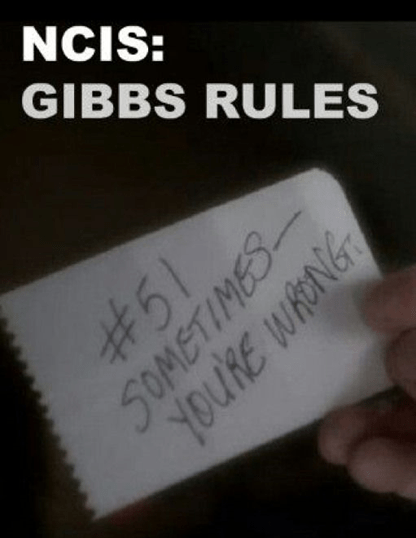
Rule 51: Sometimes you’re wrong.
The Pressure to Be Perfect
When I started my job, I didn’t just want to do well—I felt like I had to be flawless. Not just to prove myself professionally, but because I was the only Black woman on the team.
And if you know, you know. That kind of pressure isn’t just about performance—it’s about protection. It’s the feeling that if you mess up, it won’t just reflect on you. It might shape how your coworkers see the next Black woman who walks through the door.
So I tried to be perfect. No mistakes. No questions. No vulnerability. I thought if I was always on point, no one could doubt that I belonged.
But what I didn’t realize was that perfectionism was pushing people away. I wasn’t leading—I was performing. And eventually, it showed.
The Wake-Up Call
One day, my boss sat me down and said something that stopped me in my tracks:
“If you don’t learn to be vulnerable, ask for help, and admit when you’re wrong, this won’t work long term.”
At the time, I didn’t want to hear it. I wanted to defend myself. I wanted to explain. But deep down, I knew they were right.
That moment was uncomfortable as hell—but it was necessary. It forced me to face a version of myself I didn’t like: the version that didn’t know how to own mistakes or lean on others.
The Moment I Wish I Could Do Over
There was one incident I still think about—because it taught me just how much damage my need to be perfect could cause.
My team brought a mistake to my attention—something I had overlooked that was affecting our progress. And instead of listening with an open mind, I got defensive. I shut it down. I dismissed what they were saying, and in doing so, I shut them down, too.
I didn’t handle it well. And that hurt more than just the project—it hurt trust.
Later, I had to sit with that. Reflect. And own it—not just silently, but out loud. To them.
And that’s what Rule 51 is about. It’s not just about being wrong in the details—it’s about being wrong in how you respond, how you lead, how you show up. And when that happens, you’ve got a choice: cling to the image of being “right,” or choose growth.
I chose growth. And now? I lead from that place. Every day.
What Rule 51 Means for Black Women Who Lead
If you’ve ever been the “only one” in a room… If you’ve ever felt like being wrong would cost you more than your reputation… If you’ve ever pushed yourself to the brink trying to prove you’re enough…
I see you. I am you. And here’s what I know now:
Being wrong doesn’t make you less. It makes you human. And being human—that’s what makes you a stronger, more trustworthy leader.
When we give ourselves the grace to be real instead of perfect, we create space for others to do the same. That’s what real leadership looks like.
Rule 51: Sometimes you’re wrong.
Not because you’re unqualified. Not because you don’t belong. But because you’re human—and that’s what makes you powerful.
If any part of this landed with you, let it. You don’t have to comment, explain, or prove anything.
Just sit with it. Let it work on you the way it worked on me.
And when you’re ready to lead from that place—of truth, of growth, of grace—you’ll know.
We’re not aiming for perfect over here. We’re leading real.



Leave a Reply